
Minister for Education, Science, and Technology Raghuji Pant stated that the government would prioritize non-formal education that connects indigenous knowledge, skills, and arts to everyday life, in line with the National Qualifications Framework.
The Minister said this in his address to the National Non-Formal Education Conference, jointly organized by the Centre for Education and Human Resource Development (CEHRD) and UNESCO Kathmandu, in Kathmandu on Friday to commemorate the International Literacy Day, 2025.
"We possess a wealth of ancestral, traditional knowledge, but the key challenge encountered today is how to link education and skills with life. The traditional knowledge, skills, and arts are being lost to modernity."
The Ministry of Education has prepared the National Curriculum Framework for Non-Formal Education, he shared, adding that it has addressed levels 1-4 of non-formal education, and preparation for level 5 is underway.
He also emphasized the need to make a scientific interpretation of the indigenous knowledge to preserve their practices.
The Minister urged the new tech-savvy generation to revitalize the application of traditional knowledge and skills while noting, "We are not behaving well with nature, which results in the adverse impacts of climate change. The new generation is versed with technology but lacks applied knowledge to embrace and use nature."
He took the opportunity to adopt non-formal education as mere formal education could not address the lifelong learning and preserve the ancestral knowledge, nature, and food culture.
Also delivering her remarks on the occasion, Geeta Kumari Paudyal, member of the National Planning Commission, shed light on the importance of non-formal education in delivering quality inclusive education without leaving no one behind. "The non-formal education should be steered to a success so as to realize the long-term vision and goal of the 16th National Periodic Plan. As individuals aged 15-35 are still illiterate, the programme to provide non-formal education needs to be designed and delivered to engage them in skill jobs such as garment factories".
She also said the Planning Commission would assist if the Ministry of Education coordinates with other ministries to discuss the various dimensions of non-formal education.
Delivering the keynote speech on ‘Strengthening Non-Formal Education for the Promotion of Lifelong Learning in Nepal,’ education expert Dr Bimal Kumar Phuyal underlined the need to consolidate non-formal education for promoting lifelong learning in Nepal.
The approach to deal with formal education does not work for non-formal education", he said, calling for the adoption of separate legislation and an autonomous institution to encompass new non-formal education.
Likewise, Krishna Kapri, Director-General of CEHRD, informed that the national framework on non-formal education has already been formulated and will be endorsed soon. "The Community Learning Centres (CLCs) have unparalleled contributions to the expansion of literacy in Nepal. The existing mechanisms will be mobilized to establish a visible connection between non-formal education and income generation."
Jaco du Toit, UNESCO Representative to Nepal, stated that Nepal has made significant progress in expanding educational opportunities and improving literacy rates over the past few years. However, he noted that it remains challenging for marginalized groups like women, people with disabilities, indigenous peoples, and the poor to benefit equally.
He explained that UNESCO embraces literacy as a fundamental human right and the basis for lifelong learning, as envisioned in the Education 2030 Agenda and Sustainable Development Goal 4.
He added, "In today's world, advancing literacy requires a strong focus on equity and inclusion. Especially in the digital world, no one should be left behind in gaining an education."
Dinesh Ghimire, Director of the CEHRD, claimed that only one-third of the population is in formal education, and the remaining two-thirds are receiving non-formal education. He stated that digital literacy is a necessity of the age.
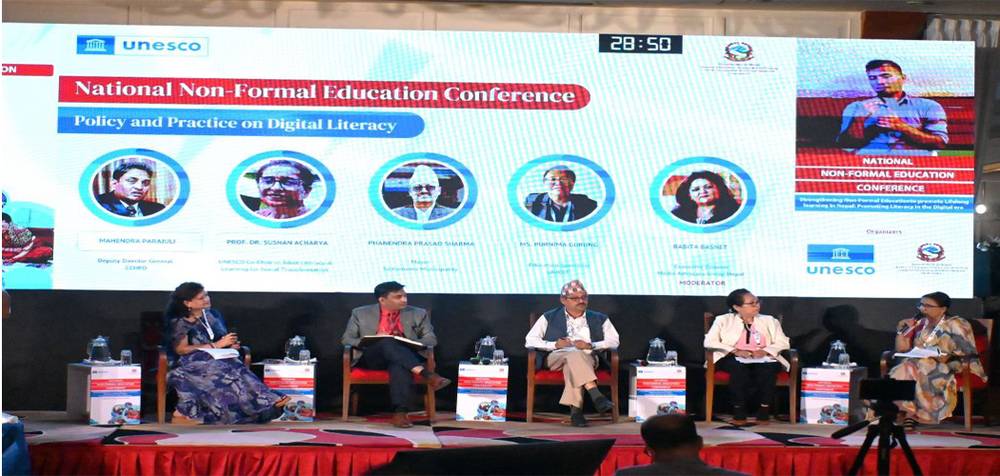
The non-formal education conference also included group discussions on various topics, including "Digital Literacy Policy and Practice" and "Youth and Adult Learning in the Digital Age".
The discussion on "Digital Literacy Policy and Practice" included views from Mahendra Parajuli, Deputy Director General of the CEHRD; Professor Dr. Sushma Acharya; Phanindra Prasad Sharma, Mayor, Sainamaina Municipality; and Purnima Gurung of UNICEF.
Similarly, the discussion on "Youth and Adult Learning in the Digital Age" involved representatives from Bagmati UNESCO Club and youth scientist, Nishchal Baniya, Netra Ghimire, Chairman of Pithuwa Community Learning Center, Ratnanagar; Jalamati Chaudhary, Education Officer of Baragadhi Rural Municipality; Rima Gurung, Assistant of Devithan Community Learning Center, Parbat; and Madhav Chaudhary, Chairman of Laxmi Community Learning Center, Saptari.