Entrance Exams
Institutions offering MDS

The Modern Computerized World demands the human resource having all three – analytical ability, data processing capability, and fast computing efficiency, i.e., the combined knowledge of Mathematics, Statistics, and Computer Science and Information Technology. Tribhuvan University has taken up this as a challenge and has decided to run a Bachelor’s and Master’s Degree Program in Mathematical Sciences that will help produce at least a critical mass of experts with sound knowledge of fundamentals of Mathematics, Statistical and Analytical capability, and fluent computational skills. To run these programs, Tribhuvan University established the School of Mathematical Sciences under the Institute of Science and Technology in 2016 at Kirtipur as its autonomous body.
Computational simulations are everywhere and the amount of data available for many enterprises is increasing exponentially. The internet makes these large quantities of data readily available for many enterprises. Many areas of science, engineering, and industry are now concerned with building and evaluating mathematical models, exploring them computationally, and analyzing enormous amounts of observed and computed data. These activities are all inherently mathematical in nature. Thus, the Master’s Program in Data Science is an ideal program to start at the School of Mathematical Sciences, TU.
Objectives
This interdisciplinary program is the first of its kind in the country. After graduation, the students will be able to
- Collect, clean, store, and query data from a variety of private and public data sources.
- Assess, evaluate and respond to decision-making needs and requirements.
- Apply appropriate analytic techniques to provide estimates that support decision-making and action.
- Communicate actionable information and findings in easy-to-understand written, oral, and visual formats.
Duration and Nature of Course
Master in Data Science is a full time, of 4 Semesters in 2 years in duration. This program basically comprises of some compulsory foundational courses consisting of fundamentals of Mathematics, Statistics, and Computer Science and Information Technology plus some elective courses from a list of courses which may vary from year to year as a multi-exit model decided by the subject committee. Total Credit: 60Nature of course: Theory, Practical, Project, Seminar, Intern, Thesis.
Eligibility
Students applying to the program are expected to have a Bachelor’s Degree with a solid quantitative and computational background, including coursework in calculus, linear algebra, and introductory statistics.
So students with B Sc CSIT, B Math Sc, B Sc. (Math), B Sc (Stat), B Sc/BA with Math / Stat in the first two years, BE, BIT, BCA (with two Math and one Stat) can apply for this program.
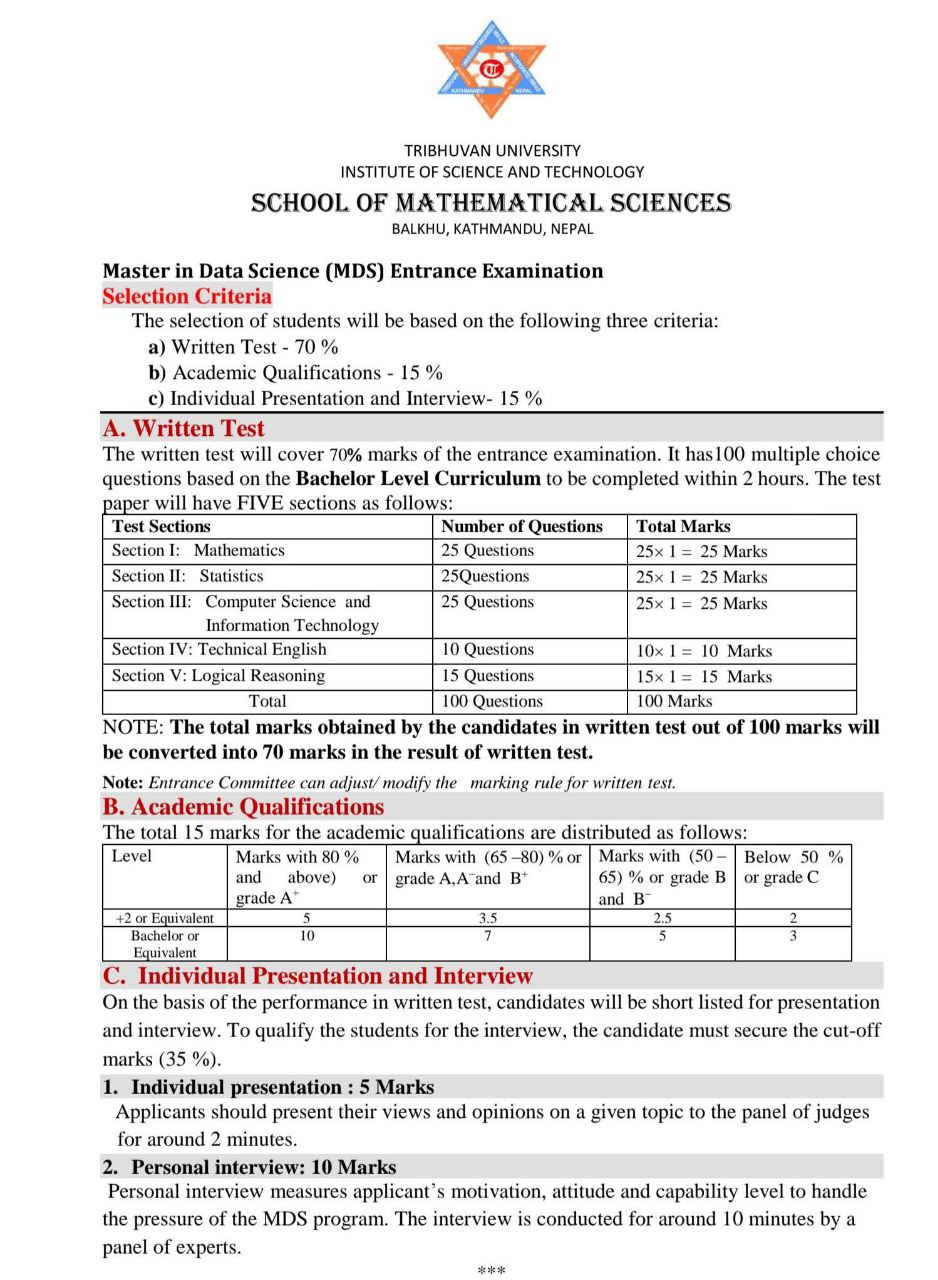
M.Sc Data Science Entrance Examination
- The weightage of the entrance examination will be 100 full marks, and the duration will be 2 hours. Questions are asked according to the B.Sc syllabus prescribed by the committee.
- The questions will be Objective or Multiple choice questions (MCQs). Each question will carry 1 (one) weightage.
- 35% marks must be obtained to pass the entrance examination.
Job Prospects
- Data scientists possess the technical savvy to unravel complex queries and the creativity to know how to get there. They work to gain insights, and ultimately find purpose in petabytes worth of unorganized, scattered, and often disparate data.
- Data scientists translate big data into innovative ideas. Now big data is no longer a hassle for IT to handle. It is a virtual gold mine of information, just waiting for data scientists to translate into innovative ideas that have implications for commercial and even social change.
- Data scientists obtain, organize, and manipulate data to gain insights. They also communicate those insights to strategists and decision-makers.
- Data scientists possess a deep understanding of organizations and industries. They support and know which questions to ask; questions that involve looking into the invisible relationship between disparate data sets.
Who is using it?
A successful business relies on quick, agile decisions to stay competitive, and most likely big data analytics is involved in making that business tick. Here is how different types of organizations might use the technology:
- Government agencies
- Clinical research centers
- Banking sector
- Manufacturing industry
- Travel and hospitality sector
- Health care industry
- Business houses
Curricular Structure
In the First and Second Semesters, students must take four compulsory courses in each semester and one course from elective courses (the necessary and relevant to them). In the Third Semester, students must take three compulsory courses and two courses from elective courses. In the Fourth Semester, students must take two compulsory courses and two courses from elective courses.
The Structure of the program is as follows:
| Semester I | |||
| Course Code | Course Title | Credits | Nature |
| MDS 501 | Fundamentals of Data Science | 3 | Th. |
| MDS 502 | Data Structure and Algorithms | 3 | Th. + Pr. |
| MDS 503 | Statistical Computing With R | 3 | Th. + Pr. |
| MDS 504 | Mathematics for Data Science | 3 | Th. |
| ----- | Elective I (Any One) | 3 | |
| Total | 15 | ||
| Semester II | |||
| Course Code | Course Title | Credits | Nature |
| MDS 551 | Programming With Python | 3 | Th. + Pr. |
| MDS 552 | Applied Machine Learning | 3 | Th. + Pr. |
| MDS 553 | Statistical Methods for Data Science | 3 | Th. + Pr. |
| MDS 554 | Multivariable Calculus for Data Science | 3 | Th. |
| ----- | Elective II (Any One) | 3 | |
| Total | 15 | ||
| Semester III | |||
| Course Code | Course Title | Credits | Nature |
| MDS 601 | Research Methodology | 3 | Th. |
| MDS 602 | Advanced Data-Mining | 3 | Th. + Pr. |
| MDS 603 | Techniques for Big Data | 3 | Th. + Pr. |
| ----- | Elective III (Any Two) | 3+3 | |
| Total | 15 | ||
| Semester IV | |||
| Course Code | Course Title | Credits | Nature |
| MDS 651 | Data Visualization | 3 | Th. |
| MDS 652 | Capstone Project/ Thesis | 3 | Project + Report |
| ----- | Elective IV (Any Two) | 3+3 | |
| Total | 12 | ||
Elective Course Listing:
| Elective I | |||
| Course Code | Course Title | Credits | Nature |
| MDS 505 | Database Management System | 3 | Th. + Pr. |
| MDS 506 | Programming Skills with C | 3 | Th. + Pr. |
| MDS 507 | Linear and Integer Programming | 3 | Th. + Pr. |
| Elective II | |||
| Course Code | Course Title | Credits | Nature |
| MDS 555 | Natural Language Processing | 3 | Th. + Pr. |
| MDS 556 | Artificial Intelligence | 3 | Th. + Pr. |
| MDS 557 | Learning Structure and Time Series | 3 | Th. + Pr. |
| Elective III | |||
| Course Code | Course Title | Credits | Nature |
| MDS 604 | Cloud Computing | 3 | Th. + Pr. |
| MDS 605 | Regression Analysis | 3 | Th. + Pr. |
| MDS 606 | Decision Analysis: Monte Carlo Methods | 3 | Th. + Pr. |
| MDS 607 | Cloud Computing | 3 | Th. |
| Elective IV | |||
| Course Code | Course Title | Credits | Nature |
| MDS 653 | Social Network Analysis | 3 | Th. + Pr. |
| MDS 654 | Actuarial Data Analysis | 3 | Th. + Pr. |
| MDS 655 | Deep Learning | 3 | Th. + Pr. |
| MDS 656 | Business Analytics | 3 | Th. + Pr. |
| MDS 657 | Bioinformatics | 3 | Th. + Pr. |
| MDS 658 | Economic Analysis | 3 | Th. + Pr. |
Evaluation System
- 40% internal evaluation and 60% external exam. Internal exams are based on Attendance/Assignment work /Oral test /Class test / Presentation /Class seminar /Project work / Term exam End semester exam by School with the permission of the exam board of TU.
- Evaluation of project or thesis: research/project monitoring by supervisor; Pre viva by the school after submission; evaluation of thesis by the Research Committee of the School with the consent of the supervisor and the external.
- In each of the semester's Exams and Internal assessments, the student must secure at least 50% in order to complete the course.
Download: