From Jeans to Dreams: Upcycling for Education is Chakraviu Nepal’s flagship “For Education” initiative that upcycles post-consumer use denim into essential school kits for students in rural public schools across Nepal. The project addresses two interconnected challenges through a single, circular solution: limited access to basic educational resources for children, and the growing burden of textile waste in urban areas.
Urban centers in Nepal generate large volumes of discarded clothing each day, much of which ends up in landfills and contributes to air, soil, and water pollution. At the same time, many students in rural public schools lack durable school bags and learning materials, directly affecting their ability to attend school comfortably and consistently. This project by Chakraviu Nepal bridges the realities by collecting old jeans from urban communities and upcycling them into functional, long-lasting school kits for children who need them most.
By combining waste reduction, local production, and educational support, the project advances environmental sustainability, strengthens livelihoods, and promotes equitable access to education. The project aligns with 6 key Sustainable Development Goals (SDGs) set forth by the UN: SDG 4- Quality Education, SDG 12- Responsible Production and Consumption, SDG 13- Climate Action, SDG 17- Partnerships for the Goals, SDG 11- Sustainable Cities and Communities, SDG 1- No Poverty
Denim is one of the most resource-intensive fabrics in the world, yet millions of pairs of jeans are discarded each year despite their durability. Globally, over 2.16 million tons of denim waste is generated annually as per a study by Luiken and Bouwhuis in 2015. As per UN, producing a single pair of jeans requires approximately 7,500 liters of water. Levis estimates that one pair of jeans can emit over 33 kg of CO₂e during its lifecycle. From Jeans to Dreams: Upcycling For Education extends the life of these materials, preventing waste while creating value where it is most needed.
.JPG)
A Three-Dimensional Impact
Education
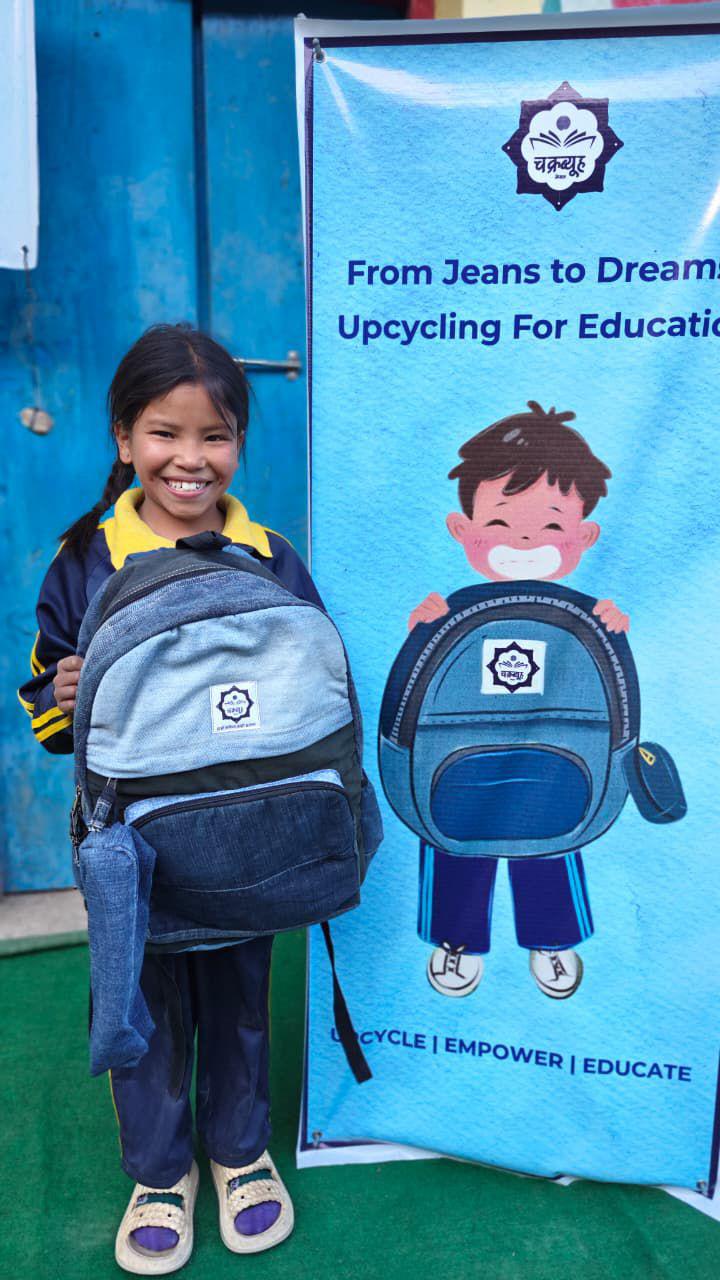
The project upcycles reclaimed denim into durable school bags and stationery pouches, distributed to students in rural public schools. These kits support daily attendance, protect learning materials, and help students participate in school with greater confidence and consistency. The focus is not on temporary aid, but on providing practical tools that students can rely on throughout their school life.
Environment
Each upcycled school bag represents a direct environmental gain:
- Extension of the life of denim that would otherwise be discarded
- Embedded water and energy preserved through reuse
- New carbon emissions avoided by replacing the need for newly produced bags
- A zero-waste approach, where all usable denim is repurposed
In addition to material impact, the project builds environmental awareness among denim donors, students, school, communities, and corporates demonstrating that sustainability can be practiced through everyday choices.
Empowerment
All stages of the upcycling process are carried out locally in Nepal. The project provides upcycling skills training and income opportunities to low-income individuals, particularly women. By keeping production local, the project supports livelihoods, values craftsmanship, and strengthens community ownership of the solution.
Why School Bags?
A school bag is a basic educational necessity that directly affects a child’s daily learning experience. For many students in rural Nepal, the journey to school is long and physically demanding, often along uneven roads and steep paths. A strong, well-made bag helps distribute weight evenly, reduces physical strain, and allows children to arrive at school ready to learn.
School bags also protect books and stationery from rain, dust, and wear. When learning materials remain intact, students are less likely to miss lessons or fall behind. Over time, these small but consistent supports contribute to stronger learning habits and confidence.
Beyond function, a school bag carries social value. It supports dignity, reduces visible inequality in the classroom, and reassures children that their education is valued. Made from reclaimed denim, the bag also becomes a daily reminder that materials can be reused responsibly, introducing sustainability in a practical, relatable way.
A Circular Model in Action
Every donated pair of jeans is fully utilized. Primary fabric panels are used for school bags and educational kits, while the remaining denim is transformed into secondary products such as tech pouches and utility bags. These products are sold to cover the costs of production, training, and future distribution, creating a partially self-sustaining loop that minimizes waste and maximizes community benefit.
Samek Palikhel, Founder and Executive Director, Chakraviu Nepal: "From Jeans to Dreams: Upcycling For Education is more than a project; it is a holistic strategy addressing education, environmental sustainability, and community empowerment simultaneously. Our goal is not to make Nepali parents dependent on donations or external organizations. Instead, we aim to equip them with practical skills and opportunities to earn a livelihood while contributing to environmental care, all the while ensuring their children have access to quality education through their own efforts."
Impact So Far
To date, From Jeans to Dreams has collected over 3,200 pairs of post-consumer jeans, transforming them into 579 upcycled school kits distributed to students in rural public schools. This work has supported 579 students across 11 public schools, ensuring consistent access to durable school bags and essential learning materials. Environmentally, the project has helped stretch the life of denim made with an estimated 22.5 million liters of water, avoided 100.2 tons of CO₂e emissions, and diverted 1,500 kgs of denim waste from landfill. Together, these outcomes demonstrate how circular thinking can be translated into practical educational support while delivering measurable environmental benefits.
The project has been implemented with support from academic institutions, private-sector partners, and local communities, reaching public schools in Southern Lalitpur and East Rukum districts. Together, these collaborations have enabled the project to reach students where support is most needed.
From Jeans to Dreams continues to grow as Chakraviu Nepal expands its partnerships, trains more upcycling artisans, and supports additional public schools. The project serves as a practical example of how waste can be reimagined as a resource and how education, environmental sustainability, and community empowerment can advance together through thoughtful, locally driven solutions.
.JPG)
An Invitation to the Reader
This is a project built on everyday choices. A pair of jeans left unused, an upcycled school kit sponsored, or a partnership formed can all become part of a system that supports children’s learning while reducing waste. Readers who wish to contribute by donating funds and/or denim, or collaborating to scale the initiative are invited to engage with Chakraviu Nepal (chakraviu.nepal@gmail.com) and help extend From Jeans to Dreams: Upcycling For Education to more classrooms and communities across the country.