
Private (institutional) schools play a significant role in Nepal’s education system. However, questions around school fees, sudden hikes, unclear charges, and parents’ rights often create confusion and concern. To address this, the Government of Nepal has introduced clear rules and guidelines to regulate how private schools determine and collect fees.
This article explains how private school fees are structured, what schools are legally allowed to charge, and what rights parents and students have, based on the Institutional School Fee Determination and Standards Directive, 2072.
Why Are School Fees Regulated?
The main objective of fee regulation is to:
- Ensure transparency in fee collection
- Prevent arbitrary or excessive fee hikes
- Balance quality education with financial fairness
- Protect parents from unauthorized charges
Every private school must follow government-approved procedures when fixing and revising fees.
How Are Fees in Private Schools Determined?
Private schools cannot set fees randomly. Monthly tuition fees must be calculated based on actual operational costs, following a defined cost-sharing structure.
Approved Cost Distribution
Schools are required to allocate their total budget approximately as follows:
- 60%: Teacher and staff salary, benefits, and welfare
- 9.5%: Scholarships and mandatory education contributions
- 14%: Rent, bank interest, and financial obligations
- 7%: Academic development (labs, library, learning resources)
- 9.5%: Institutional development and investment return
Monthly fees are then calculated by dividing the annual per-student cost into 12 months.
Types of Fees Schools Are Allowed to Charge
The directive strictly limits fee categories. Schools cannot invent new fee headings beyond those approved.
Permitted Fee Categories
- Monthly Tuition Fee: Teaching, learning activities, staff salaries
- Annual Fee: Sports, extracurricular activities, and building maintenance
- Admission Fee: One-time fee at enrollment
- Deposit (Refundable): Security deposit, refundable upon leaving
- Examination Fee: Term and annual exams, result preparation
- Computer Fee: Computer classes and lab maintenance
- Special Training Fee: Music, sports, arts, martial arts (optional)
- Hostel Fee: Only for residential students
- Meal Fee: For students using school meal services
- Transportation Fee: Only for students using school transport
- Educational Tour Fee: Educational visits and exposure programs
Any fee outside these headings is illegal.
How Are Fees Approved?
Before fees are implemented, schools must follow a multi-step approval process:
- Fee Proposal Preparation
Schools prepare a fee estimate based on annual plans and budget. - Parent–Teacher Meeting (PTA/Parent-Teacher House)
Fees must be presented and discussed with parents. - Parent Approval
- Monthly fees require discussion and justification
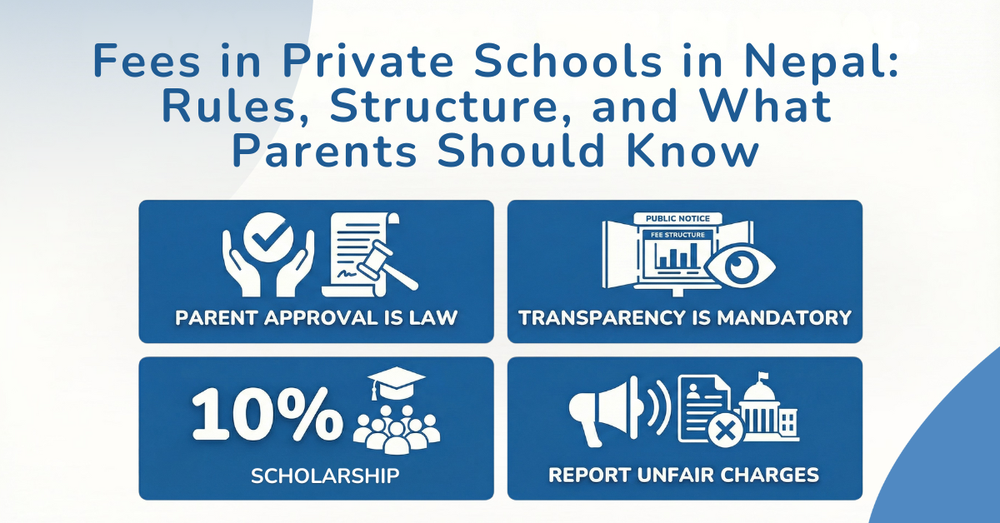
- Service-based fees (transport, hostel, special training) require approval from at least two-thirds (2/3) of concerned parents
- District Education Office Approval
Fees become valid only after official approval by the education authority.
Transparency: What Schools Must Publicly Display
Every private school is legally required to:
- Display approved fee details on a notice board at the school entrance
- Publish fee information on the school website (if available)
- Show grade-wise fee breakdown, clearly and visibly
Hidden fees or verbal charges are not allowed.
Scholarship Provisions: Who Gets Fee Support?
Private schools must provide scholarships to at least 10% of students, following government-approved criteria.
Important points:
- Scholarships must follow a defined process
- Informal discounts cannot be counted as scholarships
- Schools must maintain proper records .
Fee Collection Rules Parents Should Know
- Tuition fees are collected for 12 months only
- Admission fee is charged only once
- Exam fees cannot exceed 50% of monthly tuition
- Annual fees must be spent strictly under approved categories
- Refundable deposits must be returned when a student leaves the school.
Audits, Taxes, and Accountability
Private schools are legally required to:
- Conduct annual financial audits
- Submit audited reports to education and tax offices
- Pay applicable taxes as per Nepalese law
This ensures accountability and discourages misuse of collected fees.
What Can Parents Do If Rules Are Violated?
If a school:
- Charges unauthorized fees
- Increases fees without approval
- Fails to disclose fee details
Parents can:
- Raise concerns through the Parent-Teacher Association
- File complaints at the District Education Office
- Request justification and approval documents
School fees should reflect the cost of quality education, not confusion or pressure. Understanding how private school fees work empowers parents to make informed decisions and protect their rights. While quality education does require investment, every rupee charged must be lawful, transparent, and justified.
At Edusanjal, we encourage parents and students to ask questions, demand clarity, and choose schools that respect both education and ethics.